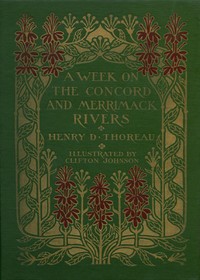
A Week on the Concord and Merrimack Rivers
- Pages
- about 419
- Category
- Philosophy
- Language
- English
- Reading time
- 7.7 h at 250 wpm
From the opening
“Beneath low hills, in the broad interval
Through which at will our Indian rivulet
Winds mindful still of sannup and of squaw,
Whose pipe and arrow oft the plough unburies,
Here, in pine houses, built of new-fallen trees,
Supplanters of the tribe, the farmers dwell.”
The Musketaquid, or Grass-ground River, though probably as old as the
Nile or Euphrates, did not begin to have a place in civilized history,
until the fame of its grassy meadows and its fish attracted settlers
out of England in 1635, when it received the other but kindred name of
CONCORD from the first plantation on its banks, which appears to have
been commenced in a spirit of peace and harmony. It will be
Grass-ground River as long as grass grows and water runs here; it will
be Concord River only while men lead peaceable lives on its banks. To
an extinct race it was grass-ground, where they hunted and fished, and
it is still perennial grass-ground to Concord farmers, who own the
Great Meadows, and get the hay from year to year. “One branch of it,”
according to the historian of Concord, for I love to quote so good
authority, “rises in the south part of Hopkinton, and another from a
pond and a large cedar-swamp in Westborough,” and flowing between
Hopkinton and Southborough, through Framingham, and between Sudbury and
Wayland, where it is sometimes called Sudbury River, it enters Concord
at the south part of the town, and after receiving the North or
Assabeth River, which has its source a little farther to the north and
west, goes out at the northeast angle, and flowing between Bedford and
Carlisle, and through Billerica, empties into the Merrimack at Lowell.
In Concord it is, in summer, from four to fifteen feet deep, and from
one hundred to three hundred feet wide, but in the spring freshets,
when it overflows its banks, it is in some places nearly a mile wide.
A short sample. Read the whole book
More to read
- "The Kingdom of God Is Within You" Christianity Not as a Mystic Religion but as a New Theory of LifeLeo TolstoyPhilosophy451 pages
- A New PhilosophyEdouard Le RoyPhilosophy169 pages
- A Plea for Captain John Brown Read to the citizens of Concord, Massachusetts on Sunday evening, October thirtieth, eighteen fifty-nineHenry David ThoreauHistory33 pages
- A Treatise Concerning the Principles of Human KnowledgeGeorge BerkeleyPhilosophy135 pages
- A Treatise of Human NatureDavid HumePhilosophy819 pages
Public-domain text from Project Gutenberg, Standard Ebooks or a similar open source. Copyright differs between countries. Rights holder? See our takedown process.