Library / Literature & Fiction
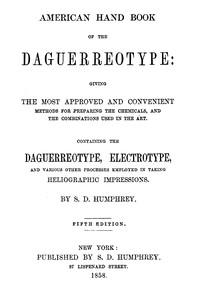
American Hand Book of the Daguerreotype
- Pages
- about 155
- Category
- Literature & Fiction
- Language
- English
- Reading time
- 2.8 h at 250 wpm
From the opening
Bromine and its Compounds—Iodine and its Compounds—Chlorine and its
Compounds—Cyanide of Potassium—Hyposulphite of Soda—Hyphosulphite of
Gold—Nitric Acid—Nitro-Muriatic Acid—Hydrochloric Acid—Hydrofluoric
Acid—Sulphuric Acid—Accelerating Substances—Liquid Sensitives—Dry
Sensitives, etc., etc., . . . . . 72
Light—Optics—Solar Spectrum—Decomposition of Light—Light, Heat, and
Actinism—Blue Paper and Color for the Walls of the Operating
Room—Proportions of Light, Heat and Actinism composing a
Sunbeam—Refraction—Reflection—Lenses—Copying Spherical
Aberration—Chromatic Aberration, . . . 131
To make Plates for the Daguerreotype—Determining the Time of Exposure
in the Camera—Instantaneous Process for Producing
Daguerreotype—Galvanizing the Daguerreotype Plate—Silvering
Solution—Daguerreotype without Mercury—Management of Chemicals—Hints
and Cautions—Electrotyping—Crayon Daguerreotypes—Illuminated
Daguerreotypes—Natural Colors in Heliography—Multiplying Daguerreotypes
on one Plate—Deposit in Gilding—Practical Hints on the Daguerreotype, .
. . 149
An Account of Wolcott and Johnson’s Early experiments in the
Daguerreotype, . . . 188
Polishing the Daguerreotype Plate—Buffing the Plate—Coating the
Plate—Exposure of the Plate in the Camera—Position—Developing the
Daguerreotype—Exposure to Mercury—Removing the Coating—Gilding or
fixing the Image—Coloring Daguerreotype.
Polishing the Daguerreotype Plate.—I shall endeavor to present to the
reader the process I have found productive of good and satisfactory
results, presenting the same in a clear and concise manner, so that any
one, by following the various manipulations given, will be enabled to
succeed. If there is any one part of the process in Daguerreotype in
which operators fail more than all others, it is in not properly
preparing the plate. It has truly been said that it would take a volume
to describe all the methods that have been suggested for polishing the
plate.
I shall confine myself to the following description, which has been
successfully practised, also most generally adopted by our operators,
and I believe equal, if not superior to any other method, yet at the
same time it is not of so much importance what particular method is
employed, so that it be thoroughly and skillfully carried out.
A short sample. Read the whole book
More to read
- "Captains Courageous": A Story of the Grand BanksRudyard KiplingLiterature & Fiction191 pages
- "Captains Courageous": A Story of the Grand BanksRudyard KiplingLiterature & Fiction191 pages
- "I Say No"Wilkie CollinsLiterature & Fiction428 pages
- "Miss Lou"Edward Payson RoeLiterature & Fiction409 pages
- "Speaking of Operations--"Irvin S. CobbLiterature & Fiction37 pages
Public-domain text from Project Gutenberg, Standard Ebooks or a similar open source. Copyright differs between countries. Rights holder? See our takedown process.