Library / Economics & Business
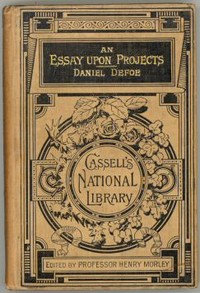
An Essay Upon Projects
by Daniel Defoe
- Pages
- about 180
- Category
- Economics & Business
- Language
- English
- Reading time
- 3.3 h at 250 wpm
From the opening
DEFOE’S “Essay on Projects” was the first volume he published, and no
great writer ever published a first book more characteristic in
expression of his tone of thought. It is practical in the highest
degree, while running over with fresh speculation that seeks everywhere
the well-being of society by growth of material and moral power. There
is a wonderful fertility of mind, and almost whimsical precision of
detail, with good sense and good humour to form the groundwork of a happy
English style. Defoe in this book ran again and again into sound
suggestions that first came to be realised long after he was dead. Upon
one subject, indeed, the education of women, we have only just now caught
him up. Defoe wrote the book in 1692 or 1693, when his age was a year or
two over thirty, and he published it in 1697.
Defoe was the son of James Foe, of St. Giles’s, Cripplegate, whose family
had owned grazing land in the country, and who himself throve as a meat
salesman in London. James Foe went to Cripplegate Church, where the
minister was Dr. Annesley. But in 1662, a year after the birth of Daniel
Foe, Dr. Annesley was one of the three thousand clergymen who were driven
out of their benefices by the Act of Uniformity. James Foe was then one
of the congregation that followed him into exile, and looked up to him as
spiritual guide when he was able to open a meeting-house in Little St.
Helen’s. Thus Daniel Foe, not yet De Foe, was trained under the
influence of Dr. Annesley, and by his advice sent to the Academy at
Newington Green, where Charles Morton, a good Oxford scholar, trained
young men for the pulpits of the Nonconformists. In later days, when
driven to America by the persecution of opinion, Morton became
Vice-President of Harvard College.
A short sample. Read the whole book
More to read
- A Journal of the Plague Year Being Observations or Memorials of the Most Remarkable Occurrences, as Well Public as Private, Which Happened in London During the Last Great Visitation in 1665. Written by a Citizen Who Continued All the While in LondonDaniel DefoeLiterature & Fiction345 pages
- After the Rain : how the West lost the EastSamuel VakninEconomics & Business306 pages
- An Essay on the Principle of PopulationT. R. MalthusEconomics & Business197 pages
- An Inquiry into the Nature and Causes of the Wealth of NationsAdam SmithEconomics & Business1385 pages
- An Inquiry into the Nature and Progress of Rent, and the Principles by Which It is RegulatedT. R. MalthusEconomics & Business49 pages
Public-domain text from Project Gutenberg, Standard Ebooks or a similar open source. Copyright differs between countries. Rights holder? See our takedown process.