Library / Literature & Fiction
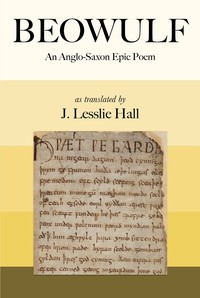
Beowulf: An Anglo-Saxon Epic Poem
by J. Lesslie, 1856-1928 [Translator] Hall
- Pages
- about 141
- Category
- Literature & Fiction
- Language
- English
- Reading time
- 2.6 h at 250 wpm
From the opening
The present work is a modest effort to reproduce approximately, in modern
measures, the venerable epic, Beowulf. Approximately, I repeat; for a
very close reproduction of Anglo-Saxon verse would, to a large extent, be
prose to a modern ear.
The Heyne-Socin text and glossary have been closely followed. Occasionally
a deviation has been made, but always for what seemed good and sufficient
reason. The translator does not aim to be an editor. Once in a while,
however, he has added a conjecture of his own to the emendations quoted
from the criticisms of other students of the poem.
This work is addressed to two classes of readers. From both of these alike
the translator begs sympathy and co-operation. The Anglo-Saxon scholar he
hopes to please by adhering faithfully to the original. The student of
English literature he aims to interest by giving him, in modern garb, the
most ancient epic of our race. This is a bold and venturesome undertaking;
and yet there must be some students of the Teutonic past willing to follow
even a daring guide, if they may read in modern phrases of the sorrows of
Hrothgar, of the prowess of Beowulf, and of the feelings that stirred the
hearts of our forefathers in their primeval homes.
In order to please the larger class of readers, a regular cadence has been
used, a measure which, while retaining the essential characteristics of
the original, permits the reader to see ahead of him in reading.
Perhaps every Anglo-Saxon scholar has his own theory as to how Beowulf
should be translated. Some have given us prose versions of what we believe
to be a great poem. Is it any reflection on our honored Kemble and Arnold
to say that their translations fail to show a layman that Beowulf is
justly called our first epic? Of those translators who have used verse,
several have written from what would seem a mistaken point of view.
A short sample. Read the whole book
More to read
- "Captains Courageous": A Story of the Grand BanksRudyard KiplingLiterature & Fiction191 pages
- "Captains Courageous": A Story of the Grand BanksRudyard KiplingLiterature & Fiction191 pages
- "I Say No"Wilkie CollinsLiterature & Fiction428 pages
- "Miss Lou"Edward Payson RoeLiterature & Fiction409 pages
- "Speaking of Operations--"Irvin S. CobbLiterature & Fiction37 pages
Public-domain text from Project Gutenberg, Standard Ebooks or a similar open source. Copyright differs between countries. Rights holder? See our takedown process.