Library / Literature & Fiction
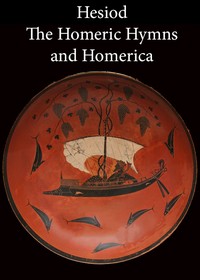
Hesiod, the Homeric Hymns, and Homerica
by Hesiod
- Pages
- about 326
- Category
- Literature & Fiction
- Language
- English
- Reading time
- 6 h at 250 wpm
From the opening
In order to make this file more accessible to the average computer
user, the preparer has found it necessary to re-arrange some of the
material. The preparer takes full responsibility for his choice of
arrangement.
A few endnotes have been added by the preparer, and some additions have
been supplied to the original endnotes of Mr. Evelyn-White’s. Where
this occurs I have noted the addition with my initials “DBK”. Some
endnotes, particularly those concerning textual variations in the
ancient Greek text, are here omitted.
This volume contains practically all that remains of the post-Homeric
and pre-academic epic poetry.
I have for the most part formed my own text. In the case of Hesiod I
have been able to use independent collations of several MSS. by Dr.
W.H.D. Rouse; otherwise I have depended on the apparatus criticus of
the several editions, especially that of Rzach (1902). The arrangement
adopted in this edition, by which the complete and fragmentary poems
are restored to the order in which they would probably have appeared
had the Hesiodic corpus survived intact, is unusual, but should not
need apology; the true place for the Catalogues (for example),
fragmentary as they are, is certainly after the Theogony.
In preparing the text of the Homeric Hymns my chief debt—and it is a
heavy one—is to the edition of Allen and Sikes (1904) and to the series
of articles in the Journal of Hellenic Studies (vols. xv. sqq.) by
T.W. Allen. To the same scholar and to the Delegates of the Clarendon
Press I am greatly indebted for permission to use the restorations of
the Hymn to Demeter, lines 387-401 and 462-470, printed in the Oxford
Text of 1912.
Of the fragments of the Epic Cycle I have given only such as seemed to
possess distinct importance or interest, and in doing so have relied
mostly upon Kinkel’s collection and on the fifth volume of the Oxford
Homer (1912).
A short sample. Read the whole book
More to read
- "Captains Courageous": A Story of the Grand BanksRudyard KiplingLiterature & Fiction191 pages
- "Captains Courageous": A Story of the Grand BanksRudyard KiplingLiterature & Fiction191 pages
- "I Say No"Wilkie CollinsLiterature & Fiction428 pages
- "Miss Lou"Edward Payson RoeLiterature & Fiction409 pages
- "Speaking of Operations--"Irvin S. CobbLiterature & Fiction37 pages
Public-domain text from Project Gutenberg, Standard Ebooks or a similar open source. Copyright differs between countries. Rights holder? See our takedown process.