Library / Literature & Fiction
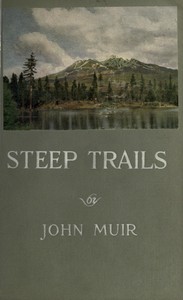
Steep Trails
by John Muir
- Pages
- about 295
- Category
- Literature & Fiction
- Language
- English
- Reading time
- 5.4 h at 250 wpm
From the opening
The papers brought together in this volume have, in a general way, been
arranged in chronological sequence. They span a period of twenty-nine
years of Muir’s life, during which they appeared as letters and
articles, for the most part in publications of limited and local
circulation. The Utah and Nevada sketches, and the two San Gabriel
papers, were contributed, in the form of letters, to the San Francisco
Evening Bulletin toward the end of the seventies. Written in the
field, they preserve the freshness of the author’s first impressions of
those regions. Much of the material in the chapters on Mount Shasta
first took similar shape in 1874. Subsequently it was rewritten and
much expanded for inclusion in Picturesque California, and the Region
West of the Rocky Mountains, which Muir began to edit in 1888. In the
same work appeared the description of Washington and Oregon. The
charming little essay “Wild Wool” was written for the Overland
Monthly in 1875. “A Geologist’s Winter Walk” is an extract from a
letter to a friend, who, appreciating its fine literary quality, took
the responsibility of sending it to the Overland Monthly without the
author’s knowledge. The concluding chapter on “The Grand Cañon of the
Colorado” was published in the Century Magazine in 1902, and exhibits
Muir’s powers of description at their maturity.
Some of these papers were revised by the author during the later years
of his life, and these revisions are a part of the form in which they
now appear. The chapters on Mount Shasta, Oregon, and Washington will
be found to contain occasional sentences and a few paragraphs that were
included, more or less verbatim, in The Mountains of California and
Our National Parks. Being an important part of their present context,
these paragraphs could not be omitted without impairing the unity of
the author’s descriptions.
A short sample. Read the whole book
More to read
- "Captains Courageous": A Story of the Grand BanksRudyard KiplingLiterature & Fiction191 pages
- "Captains Courageous": A Story of the Grand BanksRudyard KiplingLiterature & Fiction191 pages
- "I Say No"Wilkie CollinsLiterature & Fiction428 pages
- "Miss Lou"Edward Payson RoeLiterature & Fiction409 pages
- "Speaking of Operations--"Irvin S. CobbLiterature & Fiction37 pages
Public-domain text from Project Gutenberg, Standard Ebooks or a similar open source. Copyright differs between countries. Rights holder? See our takedown process.