Library / Literature & Fiction
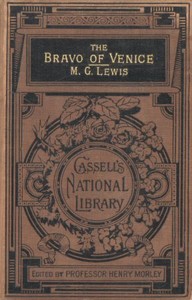
The Bravo of Venice: A Romance
- Pages
- about 123
- Category
- Literature & Fiction
- Language
- English
- Reading time
- 2.3 h at 250 wpm
From the opening
MATTHEW GREGORY LEWIS, who professed to have translated this romance out
of the German, very much, I believe, as Horace Walpole professed to have
taken The Castle of Otranto from an old Italian manuscript, was born in
1775 of a wealthy family. His father had an estate in India and a post
in a Government office. His mother was daughter to Sir Thomas Sewell,
Master of the Rolls in the reign of George III. She was a young mother;
her son Matthew was devoted to her from the first. As a child he called
her “Fanny,” and as a man held firmly by her when she was deserted by her
husband. From Westminster School, M. G. Lewis passed to Christ Church,
Oxford. Already he was busy over tales and plays, and wrote at college a
farce, never acted, a comedy, written at the age of sixteen, The East
Indian, afterwards played for Mrs. Jordan’s benefit and repeated with
great success, and also a novel, never published, called The Effusions
of Sensibility, which was a burlesque upon the sentimental school. He
wrote also what he called “a romance in the style of The Castle of
Otranto,” which appeared afterwards as the play of The Castle Spectre.
With his mind thus interested in literature of the romantic form, young
Lewis, aged seventeen, after a summer in Paris, went to Germany, settled
for a time at Weimar, and, as he told his mother, knocked his brains
against German as hard as ever he could. “I have been introduced,” he
wrote, in July, 1792, “to M. de Goethe, the celebrated author of
Werter, so you must not be surprised if I should shoot myself one of
these fine mornings.” In the spring of 1793 the youth returned to
England, very full of German romantic tale and song, and with more paper
covered with wild fancies of his own. After the next Christmas he
returned to Oxford.
A short sample. Read the whole book
More to read
- "Captains Courageous": A Story of the Grand BanksRudyard KiplingLiterature & Fiction191 pages
- "Captains Courageous": A Story of the Grand BanksRudyard KiplingLiterature & Fiction191 pages
- "I Say No"Wilkie CollinsLiterature & Fiction428 pages
- "Miss Lou"Edward Payson RoeLiterature & Fiction409 pages
- "Speaking of Operations--"Irvin S. CobbLiterature & Fiction37 pages
Public-domain text from Project Gutenberg, Standard Ebooks or a similar open source. Copyright differs between countries. Rights holder? See our takedown process.