Library / Literature & Fiction
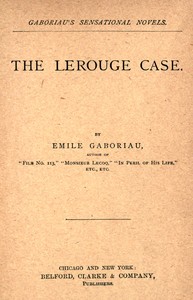
The Lerouge Case
- Pages
- about 450
- Category
- Literature & Fiction
- Language
- English
- Reading time
- 8.3 h at 250 wpm
From the opening
On Thursday, the 6th of March, 1862, two days after Shrove Tuesday, five
women belonging to the village of La Jonchere presented themselves at
the police station at Bougival.
They stated that for two days past no one had seen the Widow Lerouge,
one of their neighbours, who lived by herself in an isolated cottage.
They had several times knocked at the door, but all in vain. The
window-shutters as well as the door were closed; and it was impossible
to obtain even a glimpse of the interior.
This silence, this sudden disappearance alarmed them. Apprehensive of
a crime, or at least of an accident, they requested the interference of
the police to satisfy their doubts by forcing the door and entering the
house.
Bougival is a pleasant riverside village, peopled on Sundays by crowds
of boating parties. Trifling offences are frequently heard of in its
neighbourhood, but crimes are rare.
The commissary of police at first refused to listen to the women, but
their importunities so fatigued him that he at length acceded to their
request. He sent for the corporal of gendarmes, with two of his
men, called into requisition the services of a locksmith, and, thus
accompanied, followed the neighbours of the Widow Lerouge.
La Jonchere owes some celebrity to the inventor of the sliding railway,
who for some years past has, with more enterprise than profit, made
public trials of his system in the immediate neighbourhood. It is
a hamlet of no importance, resting upon the slope of the hill which
overlooks the Seine between La Malmaison and Bougival. It is about
twenty minutes’ walk from the main road, which, passing by Rueil and
Port-Marly, goes from Paris to St. Germain, and is reached by a steep
and rugged lane, quite unknown to the government engineers.
A short sample. Read the whole book
More to read
- "Captains Courageous": A Story of the Grand BanksRudyard KiplingLiterature & Fiction191 pages
- "Captains Courageous": A Story of the Grand BanksRudyard KiplingLiterature & Fiction191 pages
- "I Say No"Wilkie CollinsLiterature & Fiction428 pages
- "Miss Lou"Edward Payson RoeLiterature & Fiction409 pages
- "Speaking of Operations--"Irvin S. CobbLiterature & Fiction37 pages
Public-domain text from Project Gutenberg, Standard Ebooks or a similar open source. Copyright differs between countries. Rights holder? See our takedown process.