Library / Literature & Fiction
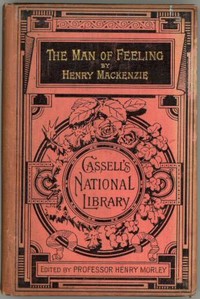
The Man of Feeling
- Pages
- about 134
- Category
- Literature & Fiction
- Language
- English
- Reading time
- 2.5 h at 250 wpm
From the opening
HENRY MACKENZIE, the son of an Edinburgh physician, was born in August,
1745. After education in the University of Edinburgh he went to London
in 1765, at the age of twenty, for law studies, returned to Edinburgh,
and became Crown Attorney in the Scottish Court of Exchequer. When
Mackenzie was in London, Sterne’s “Tristram Shandy” was in course of
publication. The first two volumes had appeared in 1759, and the ninth
appeared in 1767, followed in 1768, the year of Sterne’s death, by “The
Sentimental Journey.” Young Mackenzie had a strong bent towards
literature, and while studying law in London, he read Sterne, and falling
in with the tone of sentiment which Sterne himself caught from the spirit
of the time and the example of Rousseau, he wrote “The Man of Feeling.”
This book was published, without author’s name, in 1771. It was so
popular that a young clergyman made a copy of it popular with imagined
passages of erasure and correction, on the strength of which he claimed
to be its author, and obliged Henry Mackenzie to declare himself. In
1773 Mackenzie published a second novel, “The Man of the World,” and in
1777 a third, “Julia de Roubigné.” An essay-reading society in
Edinburgh, of which he was a leader, started in January, 1779, a weekly
paper called The Mirror, which he edited until May, 1780. Its writers
afterwards joined in producing The Lounger, which lasted from February,
1785, to January, 1787. Henry Mackenzie contributed forty-two papers to
The Mirror and fifty-seven to The Lounger. When the Royal Society of
Edinburgh was founded Henry Mackenzie was active as one of its first
members. He was also one of the founders of the Highland Society.
Although his “Man of Feeling” was a serious reflection of the false
sentiment of the Revolution, Mackenzie joined afterwards in writing
tracts to dissuade the people from faith in the doctrines of the
Revolutionists.
A short sample. Read the whole book
More to read
- "Captains Courageous": A Story of the Grand BanksRudyard KiplingLiterature & Fiction191 pages
- "Captains Courageous": A Story of the Grand BanksRudyard KiplingLiterature & Fiction191 pages
- "I Say No"Wilkie CollinsLiterature & Fiction428 pages
- "Miss Lou"Edward Payson RoeLiterature & Fiction409 pages
- "Speaking of Operations--"Irvin S. CobbLiterature & Fiction37 pages
Public-domain text from Project Gutenberg, Standard Ebooks or a similar open source. Copyright differs between countries. Rights holder? See our takedown process.