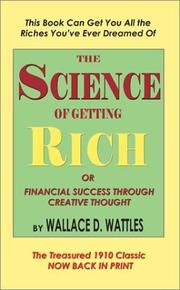
The Science of Getting Rich
- Pages
- about 83
- Category
- Finance & Investing
- Language
- English
- Reading time
- 1.5 h at 250 wpm
About the book
The Science of Getting Rich is a short guide, first published in 1910, that sets out a method for acquiring money through focused thought and deliberate action. Wattles argues that a formless creative substance responds to clear mental images, and that people who hold a definite purpose and act on it will attract the means to achieve it. Its main themes include the contrast between competitive and creative approaches to work, the value of gratitude and purpose, and the claim that prosperity is available to anyone who learns the method. The book remains widely read because of its brevity, its confident tone, and its influence on later success literature. It is often reprinted and cited in discussions of the New Thought tradition and popular self-help.
From the opening
This book is pragmatical, not philosophical; a practical manual, not a treatise upon theories. It is intended for the men and women whose most pressing need is for money; who wish to get rich first, and philosophize afterward. It is for those who have, so far, found neither the time, the means, nor the opportunity to go deeply into the study of metaphysics, but who want results and who are willing to take the conclusions of science as a basis for action, without going into all the processes by which those conclusions were reached.
It is expected that the reader will take the fundamental statements upon faith, just as he would take statements concerning a law of electrical action if they were promulgated by a Marconi or an Edison; and, taking the statements upon faith, that he will prove their truth by acting upon them without fear or hesitation. Every man or woman who does this will certainly get rich; for the science herein applied is an exact science, and failure is impossible. For the benefit, however, of those who wish to investigate philosophical theories and so secure a logical basis for faith, I will here cite certain authorities.
The monistic theory of the universe—the theory that One is All, and that All is One; that one Substance manifests itself as the seeming many elements of the material world—is of Hindu origin, and has been gradually winning its way into the thought of the western world for two hundred years. It is the foundation of all the Oriental philosophies, and of those of Descartes, Spinoza, Leibnitz, Schopenhauer, Hegel, and Emerson.
The reader who would dig to the philosophical foundations is advised to read Hegel and Emerson; and he will do well to read “The Eternal News,” a very excellent pamphlet published by J. J. Brown, 300 Cathcart Road, Govanhill, Glasgow, Scotland. He may also find some help in a series of articles written by the author, which were published in Nautilus (Holyoke, Mass.
A short sample. Read the whole book
About the author
Wallace D. Wattles (1860–1911) was an American writer and lecturer associated with the New Thought movement, a loose set of teachings holding that right thinking shapes health, prosperity, and well-being. Little is firmly recorded about his early life, and he worked across self-improvement subjects rather than in one fixed profession. He wrote this book and two companion volumes in the years before his death in 1911, so the work reflects the final stage of his output. It was written in the United States during the Progressive Era, a period of industrial growth, sharp debate over wealth and labor, and a large audience for popular advice on success. Readers should watch for several things. The central claim that a particular way of thinking produces material results is presented as a law without supporting evidence. The text treats poverty largely as a failure of mindset, which overlooks structural causes. Its spiritual vocabulary, including references to a formless creative Substance, is metaphysical rather than scientific, despite the title. Its influence on later self-help is real and worth reading critically.
Public-domain text from Project Gutenberg, Standard Ebooks or a similar open source. Copyright differs between countries. Rights holder? See our takedown process.