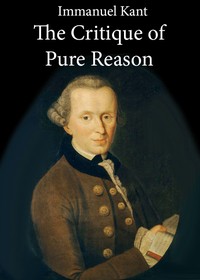
The Critique of Pure Reason
- Pages
- about 757
- Category
- Philosophy
- Language
- English
- Reading time
- 14 h at 250 wpm
From the opening
II. The Human Intellect, even in an Unphilosophical State, is in
Possession of Certain Cognitions “à priori”.
III. Philosophy stands in need of a Science which shall Determine the
Possibility, Principles, and Extent of Human Knowledge “à priori”
V. In all Theoretical Sciences of Reason, Synthetical Judgements “à
priori” are contained as Principles.
VII. Idea and Division of a Particular Science, under the Name of a
Critique of Pure Reason.
Chapter I. Of the Transcendental Clue to the Discovery of all Pure
Conceptions of the Understanding
Section I. Of the Logical Use of the Understanding in General. § 4
Section II. Of the Logical Function of the Understanding in
Judgements. § 5
Section III. Of the Pure Conceptions of the Understanding, or
Categories. § 6
Section I. Of the Principles of a Transcendental Deduction in general
§ 9
Of the Possibility of a Conjunction of the manifold representations
given by Sense. § 11.
The Principle of the Synthetical Unity of Apperception is the highest
Principle of all exercise of the Understanding. § 13
The Logical Form of all Judgements consists in the Objective Unity of
Apperception of the Conceptions contained therein. § 15
All Sensuous Intuitions are subject to the Categories, as Conditions
under which alone the manifold Content of them can be united in one
Consciousness. § 16
In Cognition, its Application to Objects of Experience is the only
legitimate use of the Category. § 18
Of the Application of the Categories to Objects of the Senses in
general. § 20
Transcendental Deduction of the universally possible employment in
experience of the Pure Conceptions of the Understanding. § 22
Result of this Deduction of the Conceptions of the Understanding. § 23
Chapter I. Of the Schematism at of the Pure Conceptions of the
Understanding.
Section III. Systematic Representation of all Synthetical Principles
of the Pure Understanding.
A short sample. Read the whole book
More to read
- "The Kingdom of God Is Within You" Christianity Not as a Mystic Religion but as a New Theory of LifeLeo TolstoyPhilosophy451 pages
- A New PhilosophyEdouard Le RoyPhilosophy169 pages
- A Treatise Concerning the Principles of Human KnowledgeGeorge BerkeleyPhilosophy135 pages
- A Treatise of Human NatureDavid HumePhilosophy819 pages
- A Week on the Concord and Merrimack RiversHenry David ThoreauPhilosophy419 pages
Public-domain text from Project Gutenberg, Standard Ebooks or a similar open source. Copyright differs between countries. Rights holder? See our takedown process.